
Haskell Interiors
Building

Haskell’s Blog

Thursday, March 8th, 2012It’s a colorful life!


Today’s crayon is GREEN

For the last few weeks we have looked at some interesting and fun facts about color.  So far we have looked at red, blue and yellow – the primary colors. And the secondary color of orange. Today we are going to look at Green created from a mixture of blue and yellow.  It is also a secondary color.

The word “Green” comes from the Old English word growan which means to grow.

Chromatherapy, which has been practiced for centuries, is the therapy of using colored lights to heal the body and mind with different colors stimulating or relaxing various parts and organs.  Green brings harmony to the body.  It is thought to be helpful for inflamed conditions and to help with ulcers and hay fever.

Green is a color that is often used to represent peace and nature, calmness and rebirth.

Hospitals often use green because of its calming effect on most people.  Research has shown that workplaces using green have workers with fewer stomachaches.  The color green’s calming effect leads to the use, “green room” where guests can wait and relax.

Hunters in the 19th century traditionally wore green, thus the term hunter green.

Researchers have found students increase reading comprehension when using green paper or ink.

Green can represent such a diverse set of meanings, perhaps more so than any other color.  For the positive, it can mean wealth, prosperity, fertility, peace, rebirth, harmony and power.  In a negative sense, it can represent jealousy, evil, sickness, inexperience.  Just think of how even today we use the word: “green thumb”, “green with envy”, “environmentally green”,

 “green around the gills”, “green movement”, “green (as a slang for money)”, “green horn”.  And just think of green visually: the green wicked witch in the Wizard of Oz,

the American dollar bill,

 a green traffic light and the four leaf clover.


Posted by Haskellinteriors at 11:09 pm
No Comments »

Tuesday, March 6th, 2012ASK HASKELL: How do I make my bookcases look less boring?


Q:  Dear Haskell,

I have these large bookcases in my den.  Right now they are filled just with books – some very nice, others just paperbacks.  Can you give me some tips on how to make my bookcases not look so boring and plain?

Thanks for your help!  Stephanie, Athens, TN

A:  Dear Stephanie,

Bookcases can be a great way to add a lot of style into any room.  Remember bookcases aren’t just for books.  They can be a great expression of your interests, hobbies, memories and family.  And, although there is no “by-the-book” (excuse my pun!) way to accessorize and layout bookshelves, here are a few helpful tips to help you achieve success:

Start by clearing off all your shelves.  It is much easier to design an eye pleasing layout, when you start with a clean slate.

If you don’t love it, leave it (off the shelf).  Discard any paperbacks, and any item that you don’t either a) love or b) have fond memories or sentimental feelings.  Your bookshelves are for showing interesting and favorite things so get rid of the junk.  (This also means the fake ivy plants from 1992!).

Start with books.  Group books by sets or similar color or size in groups of 3 – 9 and place them throughout the shelves.

Place some groups vertically and some groups horizontally for visual interest.  Play with it until you have something you like.

Next place your accessories – picture frames,  ceramics, mementos, sculptures, boxes, etc. in groups of 1 – 3 throughout.  Group similar color items together for more impact and group similar themed items together for more visual interest.

 Place smaller items on your horizontal book stacks to give the more height.

Leave some empty space.  Give your grouping some space to breathe.  Filling every shelf from  end to end gives a cluttered look.

Use the back of your bookcases.  Painting or wallpaper the back of your bookcase can give tremendous depth and punch to your treasures.

Finally, Stephanie, remember:  there is no one correct way.  Have fun with it – play around with it until you’re happy and then change it around every year or so to give your room a new look or to show off some favorite new pieces!


Posted by Haskellinteriors at 7:54 pm
No Comments »

Friday, March 2nd, 2012It’s a colorful life!


Today’s crayon is ORANGE

For the last few weeks we have looked at some interesting and fun facts about color.  So far we have looked at red, blue and yellow – the primary colors.  Today we are beginning to look at the secondary colors and will start with a current trendy color:  Orange.

Orange color originally came from Ochre that was mined from the earth.  Ochres are some of the earliest pigment dyes used by man.

Chromatherapy, which has been practiced for centuries, is the therapy of using colored lights to heal the body and mind with different colors stimulating or relaxing various parts and organs.  Orange soothes the tired body and stimulates circulation and the respiratory system.

Orange is a color that seems to spark more controversy than any other hue.  As a general rule, people either love it or hate it.

Along with red, orange is the most appetite stimulating color:  that’s why it shows up often in fast food areas.  Orange is also known to encourage conversation and stimulate imagination and creativity.  It also encourages socialization.

Orange is such a bright, extroverted color that it is often used to set things apart from surroundings, thus we have orange safety cones, construction barrels and blinking traffic lights.

And of course orange is a great choice if you are looking to excite a crowd and thus many sports teams use orange as their color including the Phoenix Suns, Cincinnati Bengals, San Francisco Giants and most importantly, our own Tennessee Volunteers!


Posted by Haskellinteriors at 12:00 pm
No Comments »

Tuesday, February 28th, 2012ASK HASKELL: Which is better – wool or nylon carpet?


Q:  Dear Haskell,

I am looking to re-carpet my home.  As I am shopping, I notice there are some wool carpet choices.  So which is better – wool or nylon?

Thanks.  Myra, Winchester, TN

A:  Myra,

As with most selections for your home, there is not one right choice for everyone or every situation.  Both nylon and wool have their own advantages.  The key is to determine which is best for you and your needs.  And, again, as with most topics in interior design, you will never get a unanimous answer either.    So, let’s take a look at both nylon carpet and wool carpet in a few key areas to see if we can see the advantages of each:

Soil resistance:  No carpet or fiber is stain proof.  Nylon carpet manufacturers have sophisticated chemicals such as Stainmaster and Wear Dated infused into the nylon yarns to help their carpets resist common stains and to be easy to clean.  Wool, by its very nature, is very resistant to soiling and stain, due to the natural oils in the wool itself.

Resiliency and Retention:  This is the ability for the fiber and thus the carpet to resist crushing and changing shape.  Due to the natural crimp in wool fiber, it is extremely resilient.  Nylon fibers, I higher end products, can be woven to also have very good resiliency.

UV Resistance to Fading:  Both nylon and wool fibers, in today’s modern carpets, can be manufactured and treated to resist fading, except in the most extreme conditions.

Flammability:  Wool wins hands down on this parameter.  Wool is naturally flame resistant and is considered self-extinguishing.  It is the required choice on airplanes and cruise ships.  Nylon can be treated to not accelerate fire and to melt, but requires a chemical process to do so.

Softness and Feel:  Again, in my opinion, wool wins this category.  No nylon can feel as soft and warm as wool; however, many are getting closer.  Wool also has a “softer” appearance.  Overall, I liken the difference between the very best nylon and the best wool as the difference between a wool coast and a cashmere coat.

Price:  Nylon has an advantage here.  Wool is thought of as a luxury, long lasting fiber, while nylon fiber tries to match its performance in many ways.  Comparing qualities, wool can be 20 – 50% more.  Although many advocates of wool claim the “value” of wool is greater due to its longevity and ease of maintenance.  It is true that there are many homes having wool carpet in great shape after 40, 50 or 60 years – my childhood home included.


Posted by Haskellinteriors at 9:49 pm
No Comments »

Thursday, February 23rd, 2012It’s a colorful life!


Today’s crayon is YELLOW

Color is all around us.  It influences our mood, our decisions and calm or quicken our hearts.  Remember, when we talk about a color, i.e. red, blue or green, that is called the hue.  When we discuss a hue’s brightness – how light or dark, how pale or intense – we are talking about value.

In 1666 scientist Sir Isaac Newton discovered that when pure white light passes through a prism it separates into all visible colors.  Newton also discovered that each color is made up of a simple wave length and cannot be separated any further into other colors.  Colors on the yellow side of the spectrum are known as warm colors.

In ancient times, yellow dyes were the least complicated and most plentiful.  They were direct dyes.  Weld; the leaves, stem and seeds of Dyers Rocket; and Safflower were all used to create various yellows.

Chromatherapy, which has been practiced for centuries, is the therapy of using colored lights to heal the body and mind with different colors stimulating or relaxing various parts and organs.  Yellow is thought to stimulate the nerves and stimulate the body.    

Yellow is always an attention getter. Yellow is the most fatiguing color to the eye due to the high amount of light that is reflected.  This factor works to an advantage for school buses and street signs where the brilliance of yellow is hard to ignore.


Studies have shown that the color yellow speeds metabolism and enhances concentration – this is one reason why legal pads are yellow! 

 Yellow has also been proven to help enhance creativity.  But for all the positive benefits, there are some reported negative effects from this bold color.  People reportedly lose their temper more often in yellow rooms.  And that fussy baby?  Studies show that babies cry more often and more easily in yellow rooms.

But not all yellow rooms need to make you cry! Yellow is an attention getter and the key is to use the color sparingly to achieve a bold effect without going overboard.  Your eye will go to yellow in any room, so remember to place accents of yellow where you want the most attention.


Posted by Haskellinteriors at 8:39 pm
No Comments »

Tuesday, February 21st, 2012ASK HASKELL: What are rules for painting the ceiling the same color as walls?


Q:  Dear Haskell,

Are there rules for when you should paint a room ceiling the same as the wall color?

Thanks.  David, Sewanee, TN

A:  David,

Great question.  Many homeowners pay little attention to the ceiling – also known as the 5th wall – when designing a space.  As with any “design rule” there are always exceptions, but here are three guidelines I work with when painting ceilings.

  1. Sloped or dormer ceilings:  Rooms with sloped walls that come down to 8’ or below or dormer (upstairs) rooms with multiple angles, look best and feel larger when the angles are painted the same color as the walls.  By painting all the angles the same as the wall color you are de-emphazing all the angles and breaks and uplifting the side angles, rather than having the heaviness of a large white angle bearing down into the space.


  1. Low ceilings:  If your ceiling is low – 8 feet high or less – or if the proportions make the ceiling height seem low, try painting the ceiling the same as the walls.  The effect is one that visually elongates the side walls and adds visual inches to the height of the room.


  1. A designer’s touch:  For regular, non-problematic ceilings, I always like to specify the ceiling color to be the exact color as my trim, except in flat finish.  I always use semi-gloss finish for trim work.  Some of my favorite whites for trim are:  Benjamin Moore White Dove and China White; Sherwin-Williams Dover White, and ICI Glidden White Room.    By painting the ceiling in the same white as the trim,  it gives the space a more custom look for no additional cost.  This also has the effect of extending the height of the room and avoids that jarring bright white that seems so cold.  I also use this color for the walls and ceilings in closets and pantries. 

 Bonus Tip:  If you have an outside porch with a ceiling, consider a wonderful shade of blue. 

 This historical detail not only adds interest and coolness on a hot summer day, but it is believed to prevent bees, wasps and spiders from making nests and webs because the blue confuses them into thinking it is the sky (this is folklore; if anyone has any real evidence, please let me know!)  Softer, paler blues that mimic a sky color tend to work best.


Posted by Haskellinteriors at 6:54 pm
No Comments »

Friday, February 17th, 2012It’s a colorful life!


Today’s crayon is BLUE


Color is all around us.  It influences our mood, our decisions and calm or quicken our hearts.  Remember, when we talk about a color, i.e. red, blue or green, that is called the hue.  When we discuss a hue’s brightness – how light or dark, how pale or intense – we are talking about value.

In 1666 scientist Sir Isaac Newton discovered that when pure white light passes through a prism it separates into all visible colors.  Newton also discovered that each color is made up of a simple wave length and cannot be separated any further into other colors.  Colors on the blue side of the spectrum are known as cool colors.  They are described as cool, calm but also can call to mind feelings of sadness or indifference.

In a recent poll, a majority of Americans stated their favorite color is blue. The color blue has long been regarded as a natural appetite suppressant based on the fact that there are few blue foods. This is why you see very few restaurants that feature blue as a predominant color or blue dining areas.  Based on a recent study when food was served on a blue plate the participants ate up to 20% less.

In ancient times, the color blue or, at least its close equivalent, was made from natural dyes of the indigo plant and woad

Chromatherapy, which has been practiced for centuries, is the therapy of using colored lights to heal the body and mind with different colors stimulating or relaxing various parts and organs.    Blue was believed to soothe illness and treat pain as well as calm the body.  Peaceful, tranquil blue causes the body to produce calming chemicals, so it is a good choice in bedrooms and medical facilities.

Fashion consultants recommend wearing blue to job interviews because it symbolizes loyalty and dependability (think about military uniforms!)

Although today, blue is used to symbolize male gender and pink for girls, in the early 1900’s it was the reverse:  blue was the color for girls (as it had been associated with the Virgin Mary) and pink for boys (as it was akin to red, considered a strong masculine color).

Don’t be blue, to your house be true.  Using blue and all of its varied and rich forms creates a good foundation for any design scheme in your home.


Posted by Haskellinteriors at 12:00 pm
No Comments »

Tuesday, February 14th, 2012ASK HASKELL: Is it OK to mount a TV over our fireplace?


Q:  Dear Haskell,

Do you think it looks OK to mount our flat screen TV over the fireplace in our den?  Some of my friends say it is OK; others say it is “tacky” and that I should still put it in a cabinet.  What do you say?

A big fan! Sheila, Dunlap, Tennessee

A:  Sheila!

Thanks for a great question.  I am confronted with this almost on a weekly basis.  From an aesthetic standpoint, I have no problem.  TV’s are a part of our daily lives and much of family life and activities center around the TV whether with movies, programs or game consoles such as X-box.  Many times I think clients spend too much effort and money on expensive cabinetry and trickery trying to hide the obvious.  Besides, from the standpoint of furniture layout, every designer will agree that is easier if both focal points – the TV and the fireplace – are on the same wall.

However, from a technical standpoint, I do have some reservations and concerns.  First, TV’s don’t like heat.  Without going into a lot of detail – direct vent vs. ventless, mantle shelf heights, etc. – let’s just say, before mounting above a fireplace, place a thermometer at the lowest point where the TV will mount.  If it registers more than the manufacturers recommended temperature you may want to re-think.  Second, I have an even greater concern with height and neck strain.  Many mantles are simply too high for a TV to be mounted above and to be viewed comfortably.  Try this:  place a post-it note where the center of the TV will be.  Then look at that spot from your normal viewing position for a few minutes to make sure it is not too high.  As a rule, the further away you are seated, the higher the TV can be mounted.  Finally make sure you securely mount your screen into proper wall studs.  It may be best to let an experienced installer handle this aspect, to make sure everything is secure and there to stay.

So, Sheila, from the designer view point, I say go for it.  But from a safety standpoint, remember:  heat, height and help (with installation).


Posted by Haskellinteriors at 3:22 pm
No Comments »

Friday, February 10th, 2012It’s a colorful life!


 Today’s crayon is RED. Color is all around us.  It influences our mood, our decisions and calm or quicken our hearts.  Beginning today and continuing for the next several weeks I will delve into some fun facts about color.  To begin, when we talk about a color, i.e. red, blue or green, that is called the hue.  When we discuss a hue’s brightness – how light or dark, how pale or intense – we are talking about value.  Today, in honor of Valentine’s Day, I will start with red.

Ancient red inks were mordant dyes; they required the use of a fixative to create an insoluble color that would remain true.  Henna, a shrub, and madder, a root, were mixed with alum (a sulphate of aluminum and potassium) to render a color family far less intense than the red we know today.  A species of female scale insect, kermes, was used by the Egyptians and produced a more vivid red. 

 Similarly, cochineal dye was used by the Aztecs with great effort (70,000 insects for one pound of dye) and to great effect, ultimately becoming Mexico’s most lucrative export after silver.

Chromatherapy, which has been practiced for centuries, is the therapy of using colored lights to heal the body and mind with different colors stimulating or relaxing various parts and organs.  The color red is said to help increase circulation and libido. 

Red is the most emotionally intense color and stimulates a faster heartbeat and breathing.  So while it is absolutely the wrong color for a baby’s room, it is a perfect color to get people excited such as a gym or activities room where increased speed and force are important.

 In the corporate world and in politics, red is seen to convey power, strength and dominance.

 And for this reason it is not advised to wear red during negotiations and delegations where one is trying to remain calm and on equal terms. Red is also a proven appetite stimulant. That is why it is the most popular color in fast food restaurants. 

Culturally, red is the universal symbolic color of life and for this reason it is traditionally worn by brides in China to express fertility and long life.

 Red is also used to convey love and giving (Valentine’s Day and Christmas).

So next Tuesday grab your crayon and paint the town red with the one you love.

Next week’s crayon is BLUE


Posted by Haskellinteriors at 9:47 pm
No Comments »

Monday, February 6th, 2012ASK HASKELL: What is correct the height for a kitchen backsplash?


Q:  Dear Haskell,

I need your help!  What is the correct for a kitchen backsplash?  I have seen some at 15” high and some at 20”?  Is there a correct height?

Thanks! Marjorie, Calhoun, Georgia

 A:  Marjorie,

That is a great question and one that has a correct answer – for you!  You see, the height of a backsplash is, in some degree, determined by your height.

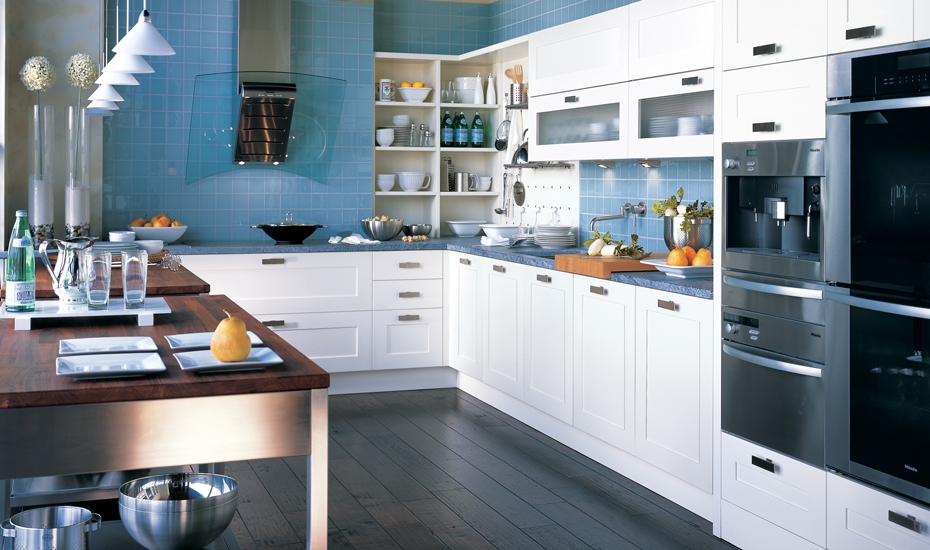
While the “normal” backsplash may be 18” above the counter, or 54” above the floor, this is just a norm.  I always advise my clients to make sure they can easily reach up to 50% of wall cabinets interior.  For most average height people, 18” off the counter will provide this.  However if you are shorter, 15” – 16” may be a better height for you.

There are some exceptions:  if you have a sink on a wall you will want to have an extra 3” – 9” of height or perhaps a shelf or mirror, so as to give you a more airy feeling without a cabinet right in front of your face.

If you have a coffee maker, mixer, espresso machine, make sure that you allow for clearance under the wall cabinetry to clear the appliance’s height.

For the area over a cook top, most hood manufacturers dictate ranges from 26” – 36” depending on model and location so please check with the manufacturer and local building codes for safety and ventilation.  I always like to maintain 32” – 36” depending on the hood style and design.

Finally, if you are short and your partner in cooking is tall, the use of plate racks, backsplash shelves and even counter top cabinets and garages are a nice compromise to keeping frequently used items easily in reach.


Posted by Haskellinteriors at 11:14 pm
No Comments »